Platform Comparison
Orchen vs ChatGPT, Claude, and Gemini
Your students are already using these tools. The real question isn't whether AI is in your classrooms, it is, but which kind of AI the school is willing to be responsible for.
ChatGPT, Claude, and Gemini are extraordinary general-purpose AI tools. For everyday research, drafting, brainstorming, coding, and personal productivity, they're genuinely best-in-class. If a student or teacher wants to use them off-school for personal work, they should.
General-purpose assistants also offer learning modes. Orchen connects guided learning to your school's classes, materials, assignments, and role-specific insight, with visibility governed by the school.
Ask both “why is the sky blue?”
In these examples, ChatGPT gives an explanation and Orchen starts with a question. ChatGPT also offers Study Mode; this example shows the responses captured here.
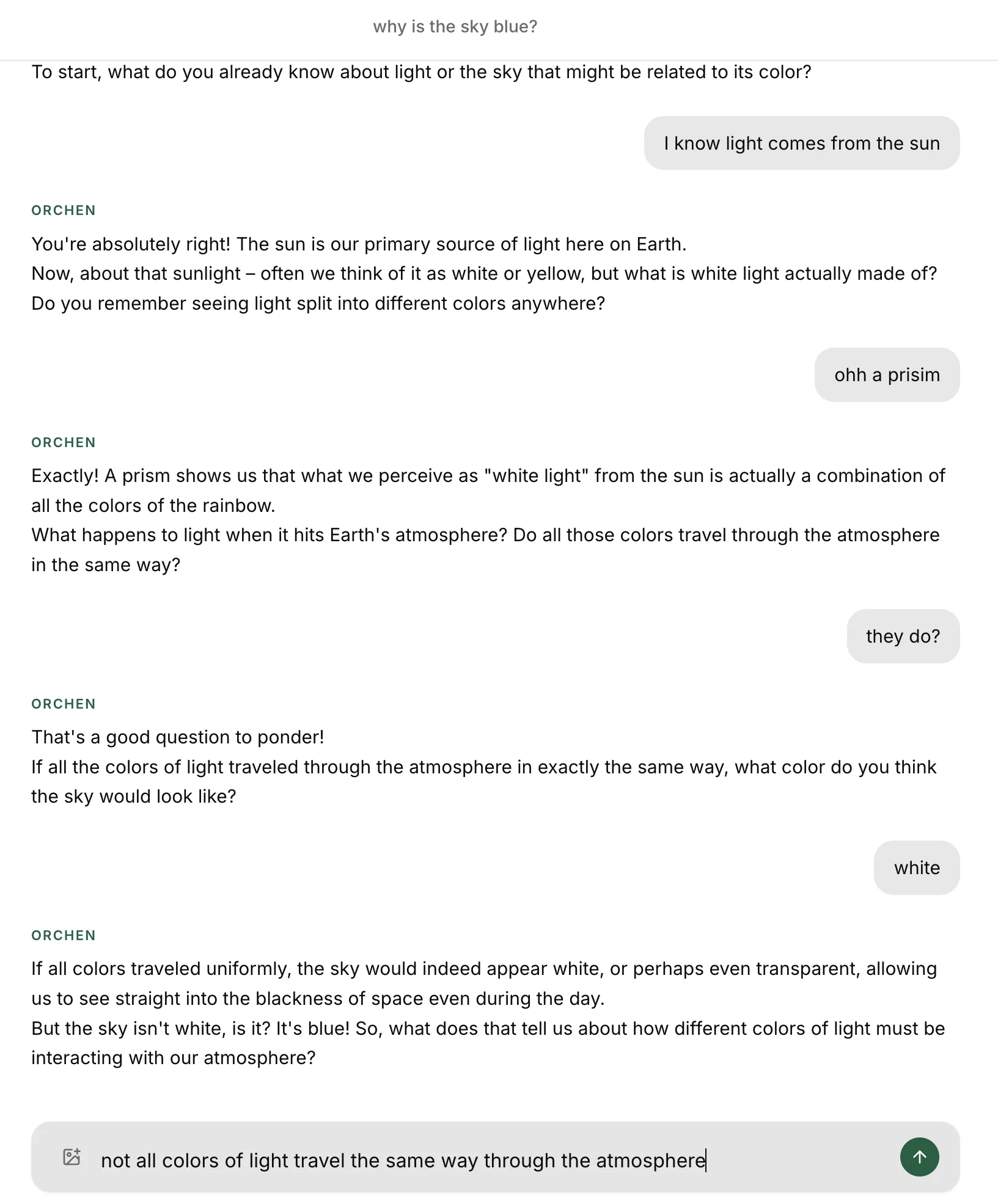
Orchen asks first. The student reasons toward the answer.
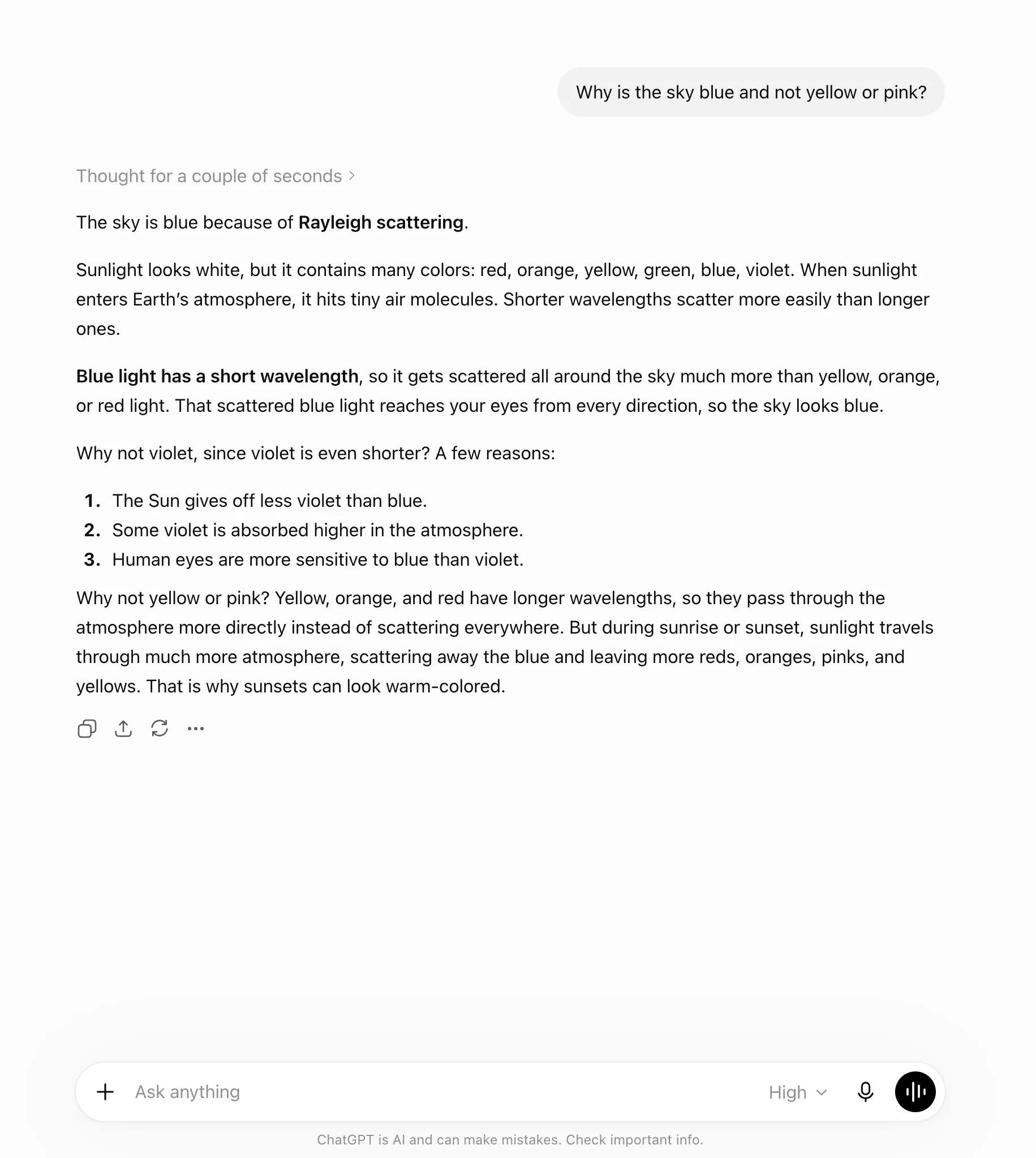
ChatGPT delivers the finished answer.
Side-by-side comparison
| Feature | Orchen | ChatGPT / Claude / Gemini (consumer) |
|---|---|---|
| Primary design intent | Curriculum-grounded learning environment connecting guided student work with school-controlled learning insight | General-purpose AI assistants designed to complete tasks for any user. No relationship with any school. |
| Pedagogy | Socratic by design, asks guiding questions and works through problems with the student. Hard-coded in the system prompt; consistent for every session. | Task-completion oriented. Asks for a task, produces the output. Will write the essay, solve the problem, summarize the reading. Some have "Study Mode" toggles but they're opt-in, easily bypassed, and not the default. |
| Configuration by the school | Schools configure the AI's identity, tone, subject focus, mechanical-feedback policy, and crisis-routing chain. Every Orchen interaction reflects the school's choices. | No school configuration. The same product, the same defaults, for every user globally. |
| Underlying model | Always-current frontier AI models. Schools don't manage model upgrades, Orchen handles that on the school's behalf. The pedagogy and architecture are Orchen's; the underlying intelligence is whatever's best available. | The same model the consumer uses on their personal account. Free tiers may use older or rate-limited models; the school has no influence over which tier a given student is on. |
| Account model | Accounts issued and managed by the school. COPPA-aware role gates for students under 13. No personal email signup. | Self-signup with personal email. Age verification is honor-system. Most have official policies against under-13 use but no enforcement that the school can rely on. |
| Visibility for teachers / advisors / parents | School-controlled learning insight: class patterns and student profiles for teachers, longitudinal context for advisors, and configurable parent summaries. | None. The school has no visibility into what students do with these tools. Conversations are invisible to faculty unless the student volunteers them. |
| Data retention | Source conversation transcripts deleted within seven days. Derived insight (learning profiles, struggle/strength tags, weekly narratives) retained per the school's configured policy. | Variable by provider, generally lengthy by default. Conversations are stored on the provider's servers; histories may be used for product improvement, abuse review, and, depending on the consumer setting, model training. The school has no control over any of it. |
| Model training on student data | Student data stays out of external model training, contractually enforced with the underlying model providers. | Varies by provider and account tier. Free-tier ChatGPT conversations may be used for training unless the user opts out. Most students don't know how, and certainly don't, opt out. |
| Crisis detection | Built-in. Concerning content is automatically flagged and routed to the school's designated counselor with a 24-hour urgency indicator and full lifecycle tracking. | Limited generalized safety responses. No school-side flag, no counselor routing, no audit trail. If a student types something concerning into ChatGPT, your school will never know. |
| FERPA / COPPA posture | Built around FERPA's parent/student record boundaries and COPPA's under-13 protections. Audit logs meet FERPA documentation requirements. | Consumer-grade ToS designed for individual users, not educational institutions. Not built for FERPA. COPPA compliance is the user's problem. |
| Pricing | School and district contracts. Per-school pricing; no consumer subscription. | Free tiers with usage caps. Paid individual subscriptions (~$20/month per user) for higher limits and newer models. Enterprise plans exist but aren't designed around K-12. |
| Business model | B2B contract with the school. Incentives are aligned with the institution paying for the product. | Subscription and free-tier driven, with the long-term business model still being defined. Several major consumer-AI providers have publicly discussed introducing advertising in their consumer products; the school has no influence over whether or when that happens, or what student-context data supports it. |
| Best for | Schools that want to take institutional responsibility for the AI students use during learning. | Personal productivity, off-school research, professional work, hobbies. Not built for classroom use, even when it happens there. |
Where ChatGPT, Claude, and Gemini are strong
These are genuine strengths, not soft-pedaled. Consumer AI tools are excellent at what they were built for.
-
✓
General knowledge and reasoning
These models are state-of-the-art across the entire range of general-purpose tasks, research, drafting, coding, creative work, translation, summarizing. For a curious student exploring outside of class, they're a remarkable resource, when used with judgment.
-
✓
Free access
Most have meaningful free tiers. For families, this is real. Students can use these tools without their family paying anything.
-
✓
Speed and breadth
Drafting, brainstorming, summarizing, coding, translating, the consumer AIs do all of this faster than any school-targeted tool. For genuine personal productivity work, that matters.
-
✓
No relationship to manage
Consumer AI tools work the moment the user signs in. There's no procurement process, no school configuration, no faculty training. For a student using them for personal projects, that simplicity is real value.
Where Orchen is different
Not better in every case. Different in ways that matter when a school is the customer.
-
◆
Grounded in your curriculum
Orchen connects the tutor to the class's own materials, current unit, assignments, and learning context. Teachers can build assignments from those same sources, and the resulting work feeds back into student and class insight.
-
◆
Socratic, not task-completing
Orchen asks before it answers. It requires the student to engage before it moves forward. It's not a setting that can be turned off, it's the architecture of the system prompt itself.
-
◆
The school decides what visibility looks like
Orchen turns student work into role-appropriate learning insight. The school controls what teachers, advisors, and families can see, with parent visibility configured separately.
-
◆
Source data deleted in 7 days
Orchen's architecture deletes source conversation transcripts within seven days of generation. What remains is derived insight, the synthesis your advisors need, without the surveillance liability of stored transcripts. Consumer tools store everything by default.
-
◆
Crisis routing is built in
Concerning content is flagged automatically and routed to your designated counselor, with a 24-hour urgency indicator and full lifecycle tracking. If a student types something concerning into ChatGPT, no adult at your school will ever see it.
-
◆
Designed around minors, not retrofitted for them
COPPA-aware role gates. FERPA-aligned audit logs. Schools configure parent visibility tiers. None of this is "settings", it's the architecture.
How to decide
Tell students to use ChatGPT, Claude, or Gemini if…
- For genuine personal-productivity tasks outside of school
- For broad research and curiosity-driven learning where you trust the student to use judgment
- For tasks where teaching isn't the goal, like drafting an email, summarizing an article, debugging code
- When you've accepted, as a school, that you have no visibility or governance over how students use AI
Adopt Orchen if…
- You want the AI students use during learning to actually teach, not just complete the work
- You want visibility into how each student is engaging with AI, without reading transcripts
- You need crisis detection that routes to a real counselor at your school
- You need to satisfy FERPA, COPPA, and state privacy law in a defensible way
- You believe the school should be responsible for the AI environment students learn inside
Frequently asked questions
Aren't ChatGPT, Claude, and Gemini better than Orchen at most things? ⌄
They are built for different jobs. ChatGPT, Claude, and Gemini are designed to complete any task for any user, fast and across every domain. Orchen runs on the same class of frontier models, focused on teaching a specific student inside a specific school, with the school in control of the data, the pedagogy, and what the adults around that student see. The right comparison is fit, not raw capability.
Can we just tell students to use the "Study Mode" or "Tutor Mode" in ChatGPT? ⌄
Those modes exist and are well-intentioned, but they're opt-in toggles in a product designed around task-completion. A student who wants the answer can switch back in a second; the school has no way to enforce or audit the mode. Orchen's Socratic posture is architectural, not a setting, it stays consistent for every student, every session.
What about privacy? My students are already typing into these tools. ⌄
That's exactly the gap. When students use consumer AI, the school has no record, no visibility, no consent management, no FERPA documentation. The student's conversations sit on the provider's servers under consumer terms, outside any institutional governance. Orchen is the version of that activity the school can take responsibility for.
Will Orchen work as well as ChatGPT for science research questions? ⌄
For broad open-ended research outside any school assignment, ChatGPT is likely more comprehensive, it's a general-purpose system. For learning a concept inside a school's curriculum, Orchen's value is that it tutors the student through the material rather than handing them an answer. They're built for different jobs.
Can students still use ChatGPT for personal projects? ⌄
Yes. Students can still use other tools outside Orchen. Orchen gives schools a curriculum-grounded workspace for guided learning and control over the visibility of work that happens there.
Is this really worth it given the cost? ⌄
Schools paying for Orchen are paying for institutional governance, not raw AI capability. The relevant comparison isn't "ChatGPT free vs. Orchen paid"; it's "consumer AI with no school oversight vs. school-governed AI with structured insight, crisis detection, and a defensible data architecture." Schools that run Orchen give students a governed home for learning, and raise the bar for what students expect from AI everywhere else.
More comparisons