The AI question lands on your desk. Make the answer defensible.
Parents are asking what your AI policy is. Faculty are split. Students decided months ago. Here's the decision you're actually making, what a governed environment looks like in practice, and board-ready answers to the questions that follow.
You're not deciding whether students use AI. That's settled.
By 2026, whether AI is in your classrooms has been answered by the students. The decision that remains is institutional, which AI environment is your school willing to take responsibility for?
Ban it
Moves the activity to personal devices, where your school has zero visibility and zero record. The use doesn't stop, your sight of it does.
Do nothing
Leaves a widening gap between what students submit and what they actually understand, a gap your faculty already report seeing.
Design the environment yourself
The AI teaches instead of completing work, the adults around each student can see how they're learning, and the data practices would survive a hostile question at a parents' evening.
Designing it means three commitments: the AI teaches rather than completes, the right adults can see real learning, and the data practices hold up under scrutiny.
The AI asks before it answers.
This is a real session. The student asks a question; Orchen responds with a question that requires their thinking first, then builds on whatever they offer, including "I'm not sure." The Socratic posture is hard-coded into the architecture, not a toggle a student can switch off.
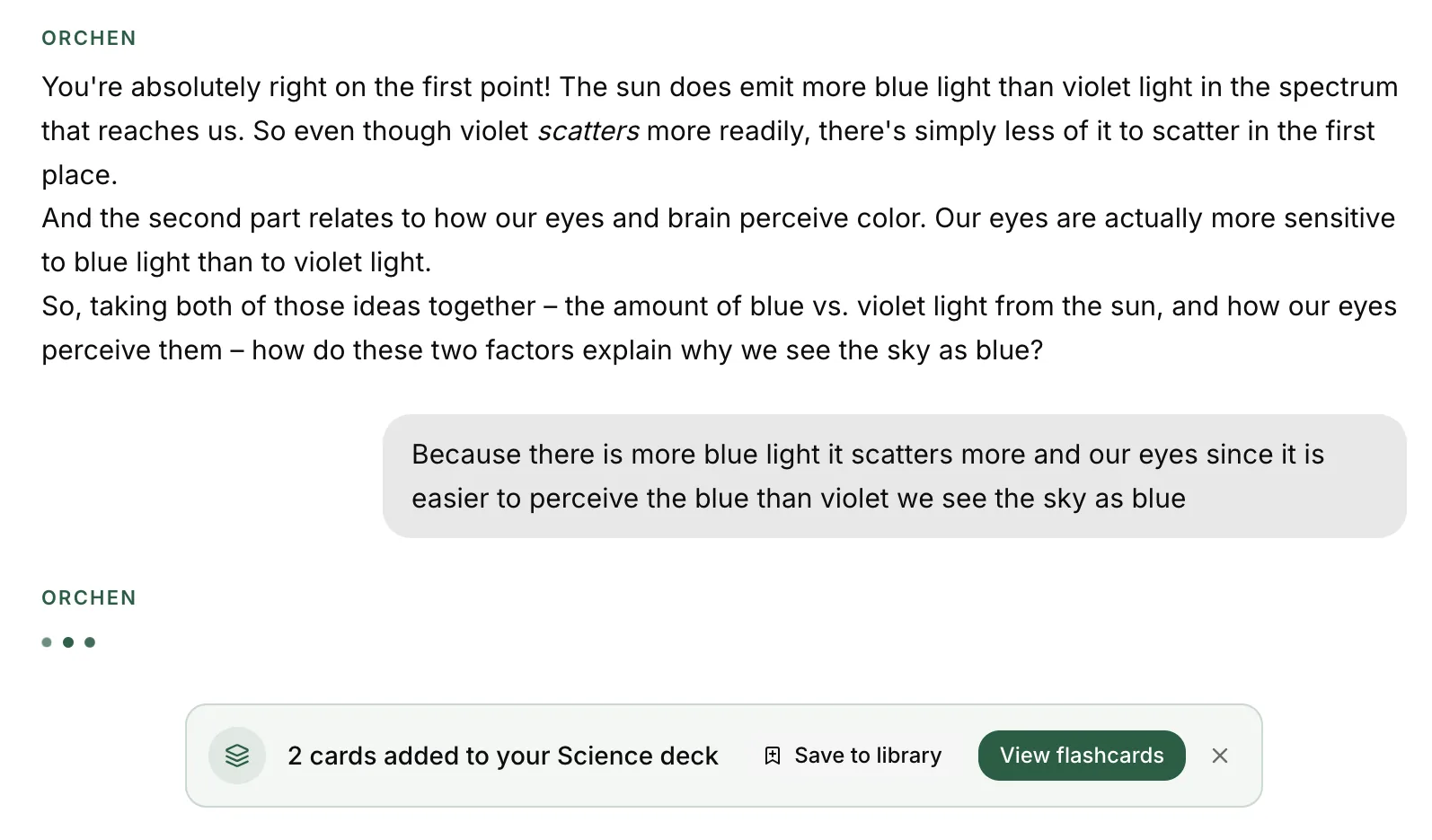
An actual student session, guided questioning, not answer delivery.
Teachers see how each student thinks, without reading transcripts.
Every conversation feeds a structured insight layer. Teachers get a plain-English read on each student's best teaching approach, learning style, struggle areas, and strengths, updated continuously, at the concept level. This is what replaces surveillance.
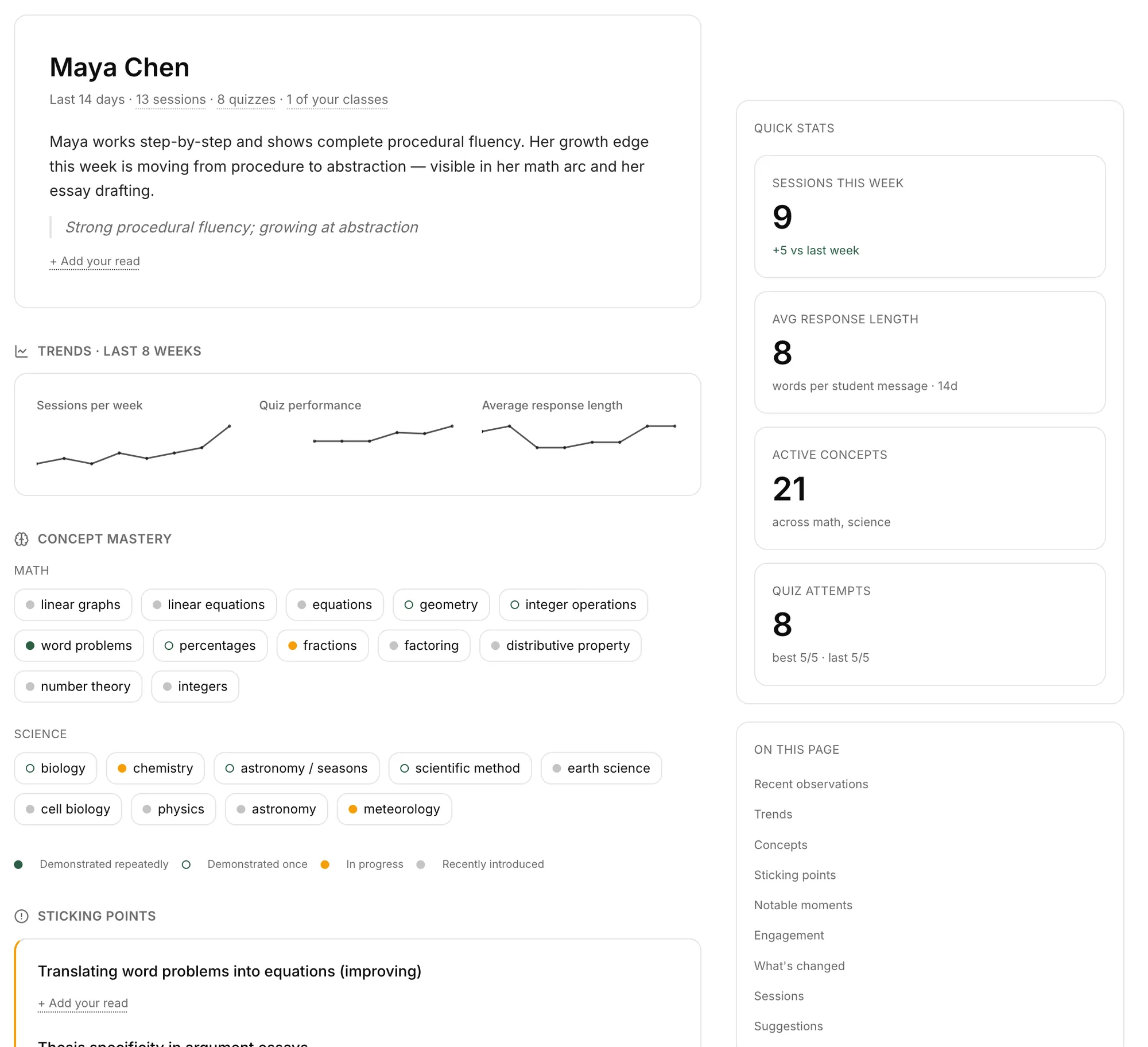
A per-student profile built from real sessions, not surveys.
Parents get a weekly picture, at the level your school sets.
The parent digest leads with a plain sentence about the week, shows bright spots and conversation starters, and ends with something concrete to do at home, governed by a five-tier visibility model your school configures. When a parent asks "what is the school doing about AI?", this screen is a better answer than any policy memo.
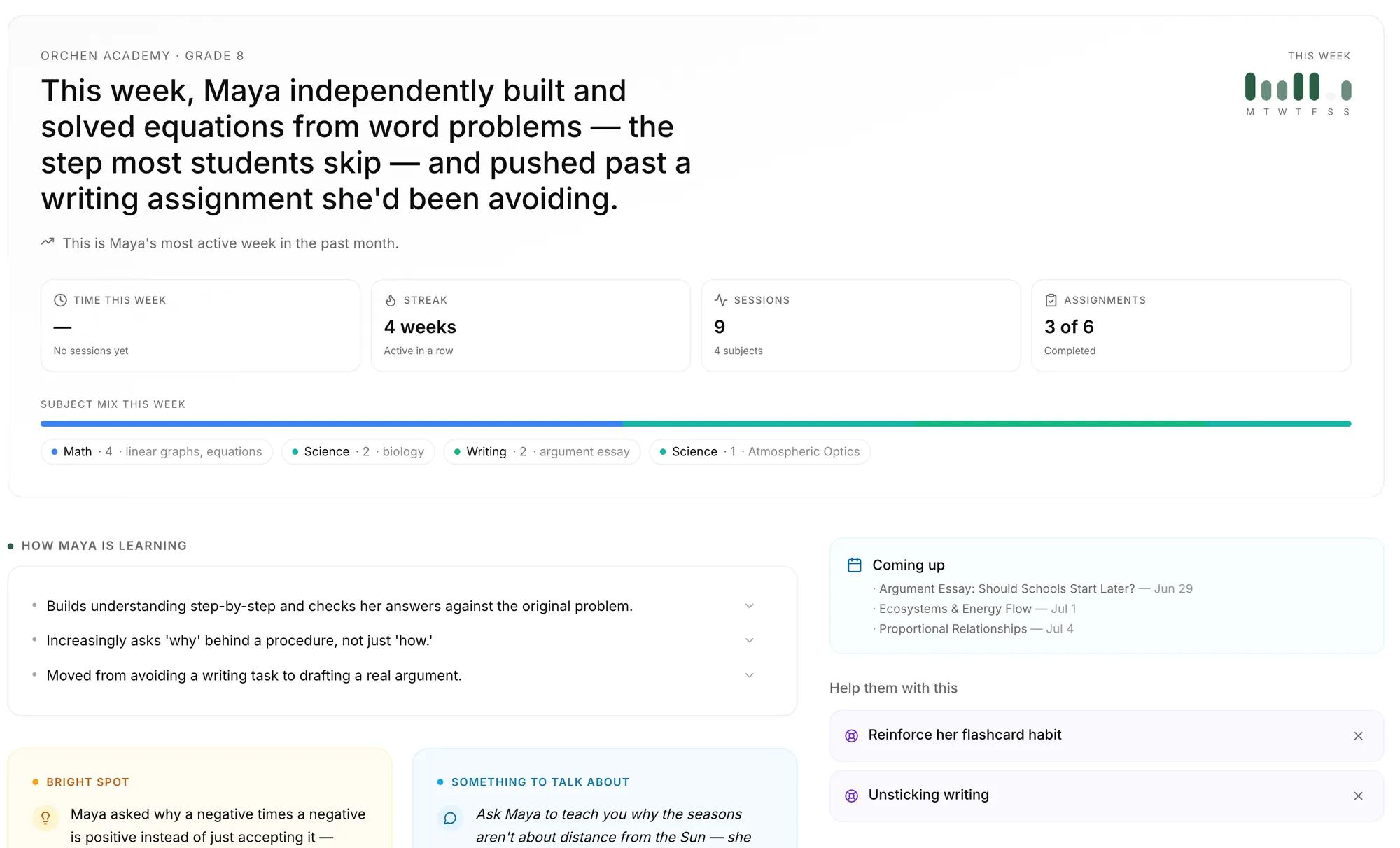
The weekly parent digest, signal, not chat logs.
The five questions your board will ask, with answers.
The objections are predictable, which means they're answerable. Here are the five that come up in every board conversation, each with a direct response.
"Won't this just help students cheat faster?"
It's built to do the opposite. The architecture refuses to complete student work; it guides through questions, partial examples, and checks for understanding. Independent monitoring shows 95% of unguided student-AI use is work completion, this is the counter-design, with the data to show engagement rather than offloading.
"What happens to our students' data?"
Source conversations are deleted within seven days; what persists is derived insight under your retention policy. No data sales, no advertising, no model training on student data, and an immutable audit log of every staff access, documented in our Trust Center.
"It's an early-stage company. What's our exposure?"
Contractually: the school owns its data, can export at any time, and has a 30-day export window after termination for any reason. Practically: founding pilots run with a small cohort at minimal cost, so a failed pilot costs weeks of one class's time, not a budget line.
"How do we explain this to families?"
With the product itself. Parents receive a school-configured weekly digest, clear, calm, and useful at home. The five-tier visibility model lets you calibrate openness against student privacy, and the policy is yours to set, not ours.
"What are we committing to?"
A scoped pilot first: one or two classes, six to eight weeks, success measures defined up front, clean exit terms. Full deployment is a separate decision made after the pilot has produced evidence. See the Founding Schools program for the structure.
Everything you need to evaluate us.
The AI policy brief →
The research, a decision framework, and a policy checklist, written to be forwarded to your board as-is.
Trust Center →
Data lifecycle, security architecture, sub-processors, and an honest account of our compliance roadmap.
Honest comparisons →
Orchen vs. SchoolAI, Khanmigo, MagicSchool, and the consumer AIs, including when the other tool is the right call.
The research brief →
The cited research on what AI is actually doing in classrooms, the evidence base behind all of this.
The AI Policy Brief, written to be forwarded.
The cited research, a three-option decision framework, and a twelve-question vendor checklist that applies to any platform, including ours. Board-ready and free.
Thirty minutes. Bring your hardest questions.
A walkthrough of the live product against your school's situation, with the founder. If it's not a fit, you'll hear that from us first.
Book a walkthrough →Or apply directly to the Founding Schools program.